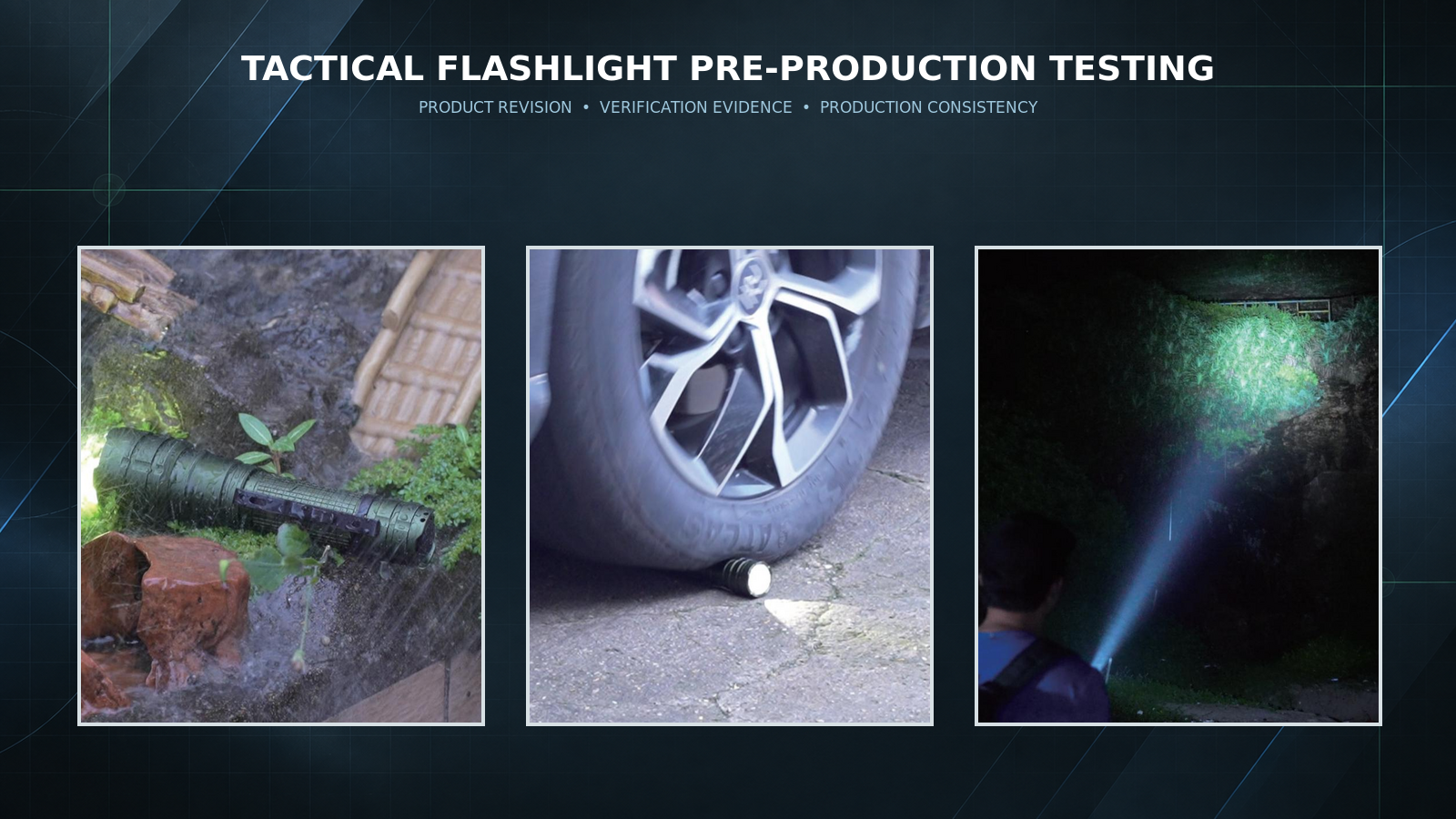

Mass production should begin only after buyers have verified not just a product sample, but the controlled revision, performance evidence, pilot-production results and process conditions needed to reproduce that performance consistently.
Defined configuration
Tested against criteria
Process-produced proof
Controlled repeatability
What should tactical flashlight buyers validate before mass production?
Before mass production, tactical flashlight buyers should verify that the approved product revision meets defined optical, electrical, thermal, mechanical and environmental requirements and that the production process can reproduce those results across representative units.
Tactical flashlight pre-production testing should connect a controlled specification to a defined test method, acceptance criteria, an approved or golden sample, pilot-production evidence and a production control plan. Buyers should confirm the controlled specification, test evidence, golden sample, pilot production, production consistency and change control before release. One strong engineering sample can show that a design can work; it does not prove that the same revision, components, firmware where applicable, assembly conditions and inspection process will reproduce the result in a future lot.
One Excellent Sample Does Not Prove Mass-Production Consistency
An engineering sample may use hand-selected components, extra engineering attention, manual adjustment, limited production tools or prototype packaging. It can be excellent while the normal line process is still unproven. A sample proves that the design can work; production validation asks whether the process can reproduce it.
Do not approve the batch by approving only the best unit. One perfect sample may not represent normal assembly variation, component lots, production tooling, line operators, final firmware, final packaging or the production inspection process.
REQUIREMENT → SPECIFICATION → TEST METHOD → ACCEPTANCE CRITERIA → ENGINEERING SAMPLE → REVISION → APPROVED SAMPLE → PILOT PRODUCTION → PRODUCTION-REPRESENTATIVE VERIFICATION → RELEASE / HOLD → MASS PRODUCTION → ONGOING CHANGE CONTROL
Engineering Sample, Golden Sample, Pilot Sample and Mass-Production Sample Are Not the Same Thing
Each stage answers a different question. An engineering sample explores the design direction. An approved or golden sample establishes the agreed product reference. A pilot-production sample checks whether the actual process can reproduce that reference. A mass-production inspection sample helps assess whether a specific lot remains within approved requirements.
| Sample Stage | Main Question | Typical Evidence | What It Does Not Prove Alone |
|---|---|---|---|
| Engineering Sample | Can the design direction work? | Function and development review | Stable production process |
| Approved / Golden Sample | What exact product is approved? | Controlled reference and records | Repeatable line output |
| Pilot-Production Sample | Can the process reproduce it? | Pilot lot, issues and retest evidence | Every future lot conforms |
| Mass-Production Inspection Sample | Does this lot meet requirements? | Lot-linked inspection records | Original design qualification |
Freeze the Product Revision Before Asking the Factory to Repeat It
“Latest version” is not a controlled production instruction. Before pilot production, buyers should identify a revision ID, date and controlled record for the product drawing, BOM, PCB, firmware if applicable, LED and optical configuration, battery configuration, housing and finish, logo artwork, packaging artwork and accessories.
MECHANICAL + OPTICAL + ELECTRONIC + FIRMWARE + BATTERY + CMF + PACKAGING
The factory cannot reproduce “the approved product” unless the approved product is defined.
A freeze does not mean no future change is possible. It means the current production reference is clear. A later change should move through change, review, revalidation where needed, approval of a new revision, then controlled production.
Verify Peak Output, Sustained Output and Beam Performance Separately
For tactical flashlight pre-production testing, buyers should bind initial output, sustained output, peak beam intensity where specified, beam profile, hotspot and spill where relevant, and sample-to-sample variation to the same approved revision and test conditions. For a multi-channel design, each channel and any combined state need their own review.
A headline number is difficult to control unless mode, battery condition, test timing, ambient condition and acceptance method are defined. A specification becomes controllable only when the measurement condition and acceptance method are defined.
Peak behavior answers an initial-performance question. Sustained behavior shows what happens after the electrical and thermal system stabilizes. Buyers can review relevant tactical flashlight platforms and handheld flashlight platforms by the target application, then define project-specific criteria before approval.
Runtime and Thermal Behavior Need Curves, Conditions and Sample Revisions
A single runtime statement does not show the output profile. Buyers should request the test mode, battery condition, ambient condition, output-versus-time curve, step-down point or behavior, sustained region, end condition, relevant temperature data and sample revision.
One product may begin at a high output and step down significantly; another may begin lower and remain more stable. Their total durations can appear similar while the user experience differs. Runtime duration and runtime profile are different validation questions.
Temperature results depend on ambient conditions, airflow, starting condition, hand-held or bench setup, battery and mode. Reports should identify those conditions rather than presenting an unexplained number.
Charging and Battery Behavior Should Be Approved as Part of the Product System
“It can charge” is not enough. Depending on the product architecture, buyers should review charging start, indicator behavior, completion behavior, connector fit, included cable or interface, battery installation, polarity protection if applicable, low-battery behavior and sample-to-sample consistency.
A replaceable-cell product needs an approved cell specification; a built-in pack needs an approved pack, cell and protection configuration. A battery substitution can change runtime, voltage behavior, current capability, charging and thermal behavior even when the replacement appears physically similar. Battery configuration is therefore a key BOM-control item.
Switch and UI Validation Must Cover Both Function and Repetition
Function review can include activation, mode order, source switching, memory or lockout where applicable, and indicator behavior. Durability review can include repeated operation, tactile consistency, mechanical looseness and electrical response. Cycle targets and acceptance criteria should come from the product requirement and validation plan, not a universal number.
Where firmware applies, UI approval must be linked to the approved firmware revision. Software changes can create a different product behavior without changing the housing, including mode order, memory, indicators, step-down and protection behavior.
Water and Drop Claims Need Claim-Specific Verification
Water resistance and drop or impact resistance are different validation subjects. If an ingress-protection claim is part of the approved specification, the verification method and evidence should match that claim. An IP classification is not a general “waterproof forever” promise.
For an impact claim, a post-test review should examine more than whether the light still turns on. Depending on the product, buyers should also review the housing, lens, switch, charging interface, battery retention, beam alignment, mechanical looseness and mode operation. Not every qualification test needs to be repeated destructively on every production unit; design qualification and production inspection serve different purposes.
The Golden Sample, BOM, Firmware and Test Criteria Must Describe the Same Product
A physical approved sample is valuable, but it is incomplete without its controlled drawing, BOM, PCB revision, firmware where applicable, battery, optics, finish, logo, accessories, packaging and test requirements. A physical golden sample without controlled documentation is an incomplete production reference.
The golden sample shows what was approved; controlled documentation explains how production reproduces it. A signed unit alone does not explain approved components, process instructions or test criteria.
Pilot Production Tests the Process, Not Just the Product
Pilot production examines whether actual tooling, assembly steps, operators, inspection stations, component supply, work instructions, test fixtures, packaging and traceability work together. Pilot quantity should reflect production risk, process complexity, tooling maturity and buyer requirements rather than a universal quantity.
A pilot is not valuable because it has no issues. It is valuable because it exposes weakness before volume. The critical question is whether the issue has a root cause, correction and verification record.
Pilot Evidence Pack: pilot quantity or lot reference, sample revision, BOM revision, test results, defect or issue log, corrective actions, retest evidence, packaging check and production-readiness decision.
For OEM/ODM projects, OEM/ODM flashlight development should connect engineering decisions to pilot evidence before a production-release decision is made.
Batch Consistency Is the Difference Between a Good Sample and a Good Product Program
Flashlight batch consistency means that key characteristics remain within approved requirements across representative production units and lots. It does not mean every unit is mathematically identical. Critical-to-quality characteristics are the items whose variation can materially affect function, performance, safety, fit or customer acceptance.
A favorable average output can conceal units outside the approved range. Buyers should consider individual conformance and relevant variation, not an average alone.
Variation may come from LED or emitter lots, battery lots, PCB components, switches, optics, housing tolerances, finish, assembly, firmware, thermal interfaces, packaging, operators, process conditions or test fixtures. A production lot may also use multiple component lots, so traceability should connect the finished product to relevant material, process and inspection records at the level required by the project.
A Component Change Can Create a New Product Behavior Without Changing the Product Name
A change to an LED, optic, battery, driver component, switch, PCB component, MCU, firmware, material, surface process, adhesive or packaging component can require new evaluation. Supplier substitution is not automatically bad; supply chains sometimes need an approved alternative. The risk comes from silent substitution without review or evidence.
CHANGE REQUEST → REASON → RISK REVIEW → SAMPLE / EVIDENCE → REVALIDATION → BUYER APPROVAL WHERE REQUIRED → NEW REVISION → PRODUCTION
A supplier-lot change does not automatically require full qualification every time, but critical components should have appropriate incoming and production controls. The right depth depends on architecture and risk.
A Test Without Traceable Records Is Weak Production Evidence
Records should connect the product, revision, lot or batch where applicable, date, test, relevant equipment or fixture, result, disposition and operator or record ID where appropriate. The purpose is not paperwork volume. It is to answer: what was tested, which revision was tested, and what was the result?
Controls for relevant materials and components.
Controls at key assembly points.
Final functional, visual and required production checks.
Final inspection is a detection layer, not a substitute for a controlled manufacturing process. A pre-shipment check can identify some results but cannot, by itself, explain why an issue occurred or prevent recurrence.
A factory image can show equipment presence. It cannot prove that a specific flashlight revision was tested, passed, used the correct method or met the required criteria. Evidence should connect the test, the sample and the result.
Tactical Flashlight Pre-Production Validation Matrix for B2B Buyers
| Validation Area | Buyer Question | Evidence | Release Risk if Unclear |
|---|---|---|---|
| 1. Product Revision | What exact revision is being released? | Controlled drawing and approval | Ambiguous product reference |
| 2. BOM Revision | Which components are approved? | Controlled BOM | Uncontrolled substitution |
| 3. Firmware Revision if applicable | Which behavior is approved? | Revision-linked review | Unexpected UI behavior |
| 4. Peak Output | Under what conditions is it checked? | Defined method and result | Unclear initial performance |
| 5. Sustained Output | How does output stabilize? | Time-based evidence | Misleading user experience |
| 6. Peak Beam Intensity | Is directional performance controlled? | Revision-linked test | Inconsistent reach |
| 7. Beam Profile | Are alignment and symmetry acceptable? | Beam review | Optical variation |
| 8. Runtime Curve | What happens over time? | Curve and conditions | Single-number approval |
| 9. Thermal Behavior | How is thermal response reviewed? | Conditioned evidence | Unknown step-down response |
| 10. Charging | Does the system behave correctly? | Functional checks | Field charging complaints |
| 11. Battery Configuration | Is the energy system controlled? | Approved specification | Performance shift |
| 12. Switch / UI | Is behavior repeatable? | Function and repetition review | Inconsistent operation |
| 13. Mechanical Durability | Are relevant mechanics reviewed? | Project test evidence | Field reliability risk |
| 14. Water / Ingress Claim | Does evidence match the claim? | Claim-specific evidence | Unsupported claim |
| 15. Drop / Impact Claim | What remains functional afterward? | Post-test inspection | Hidden damage |
| 16. Cosmetic / Finish | Is commercial appearance defined? | Approved sample and criteria | Retail inconsistency |
| 17. Packaging / Artwork | Does it match the product revision? | Artwork approval | Incorrect market information |
| 18. Pilot Production | Can the actual process reproduce it? | Pilot records and actions | Unproven process |
| 19. Production Test Plan | What is checked in production? | Defined control plan | Late defect detection |
| 20. Change Control | How are deviations approved? | Controlled record | Undocumented product change |
What Makes a Higher-Specification Positioning More Credible?
A premium positioning is an evidence claim, not a price adjective. Higher price, higher lumens, more functions or a heavier body do not independently verify quality. Credibility comes from controlled materials, controlled revision, verified output, sustained performance, beam consistency, UI consistency, mechanical durability, environmental evidence where claimed, finish consistency, traceable records, change control and flashlight batch consistency.
| Evidence Type | What It Can Show | What It Cannot Prove Alone |
|---|---|---|
| Factory Evidence Machines, lines, facility, quality system |
Potential production support and process context | Specific product-revision performance |
| Product Evidence Test result, revision, pilot sample, batch record |
How a defined product performed | Every unrelated product will perform the same |
A large factory can support production capacity, but specific product performance still requires product-level evidence. Certification and manufacturing consistency are related quality topics, but they are not the same evidence.
Specification-to-Evidence Matrix
| Specification Claim | Verification Evidence | Sample Stage | Production Control |
|---|---|---|---|
| Peak Output / Beam | Defined condition and result | Engineering, golden, pilot | Revision-linked functional checks |
| Sustained Output / Runtime / Thermal | Curve, conditions and revision | Engineering and pilot | Controlled components and review |
| Charging / Battery / UI | Functional and revision evidence | Golden and pilot | BOM, firmware and line controls |
| Ingress / Drop Claim | Claim-specific verification | Qualification and pilot as needed | Relevant process controls |
| Finish / Packaging | Approved reference | Golden and pilot | Artwork and appearance control |
CLAIM → TEST METHOD → ACCEPTANCE CRITERIA → TEST RESULT → APPROVED REVISION → PRODUCTION CONTROL
A specification without a verification path is difficult to control in mass production.
Production Consistency Checklist
Five Mistakes Buyers Make Before Releasing a Tactical Flashlight to Mass Production
A development unit can be better controlled than ordinary production. Approval should include process-produced evidence, not only appearance and function of one unit.
A signed sample without linked documents leaves too much interpretation during production.
Peak output does not show thermal behavior, runtime profile or stabilized performance.
Final inspection detects some results; it cannot replace controlled materials, process instructions and in-process controls.
A reasonable alternative can still affect performance. Review the risk, create evidence and approve a new revision where needed.
Eighteen Tests or Reviews Buyers Should Consider Before Mass Production
Acceptance criteria should remain project-specific. A practical strategy layers design or qualification testing, pilot or process validation, and ongoing production control. Different test layers answer different questions.
Buyer Evidence Pack, Questions and Review Agenda
What Should Be in a Pre-Production Evidence Pack?
1. Approved Product Specification; 2. Approved Drawing Revision; 3. Controlled BOM; 4. PCB / Firmware Revision if applicable; 5. Golden Sample Reference; 6. Optical Test Evidence; 7. Runtime / Thermal Evidence; 8. Charging / Battery Evidence; 9. Mechanical / Switch Evidence; 10. Environmental Test Evidence if claimed; 11. Packaging / Artwork Approval; 12. Pilot-Production Results; 13. Production Test Plan; 14. Change-Control Record.
Pre-Production Review Meeting Agenda
1. Final Product Revision; 2. Open Engineering Issues; 3. Golden Sample; 4. BOM / Approved Alternatives; 5. Firmware if applicable; 6. CTQ Items; 7. Pilot Results; 8. Production Flow; 9. Test Fixtures / Test Plan; 10. Packaging / Artwork; 11. Traceability / Change Control; 12. GO / HOLD Actions.
Twenty Questions Buyers Should Ask Before Mass Production
1. What exact revision are we producing? 2. Which BOM is approved? 3. Are alternative components approved? 4. Which firmware is approved? 5. Which tests were completed? 6. Which were completed on production-representative units? 7. What changed after engineering samples? 8. What did the pilot reveal? 9. Which characteristics are CTQ? 10. How are output and beam verified? 11. How is runtime tested? 12. How is charging checked? 13. How is switch/UI consistency controlled? 14. How are environmental claims verified? 15. What tests are destructive? 16. What is checked at end of line? 17. What records are retained? 18. How are component changes approved? 19. What open issues remain? 20. What evidence supports release?
Mass-Production Release Should Be an Evidence Decision, Not a Calendar Decision
Evidence supports approved requirements and the pilot process is controlled.
Critical evidence is missing or significant unresolved issues remain.
A meaningful product, component, firmware or process change requires new evidence.
This is a buyer decision framework, not an industry-mandated rating system. Missing evidence means the buyer cannot yet verify the claim; it does not automatically prove that the product fails the requirement.
An open-issue register should record the issue, risk, owner, action, verification and disposition. Not every small issue must block release, but shipping deadlines, exhibition dates and purchase-order urgency do not create technical evidence.
“Sample looks good. Please start mass production.”
Better Approval:Approved Product Revision + Golden Sample + BOM + Firmware if applicable + Test Evidence + Pilot Status + Open Issues + Production Release Decision
Four Direct Answers for B2B Buyers
Buyers should review output, beam, runtime, thermal behavior, charging, battery configuration, switch and UI function, relevant mechanical and environmental claims, documentation, pilot evidence and production consistency. The exact test plan should follow the product requirement, risk and target-market needs.
No. An approved sample is a product reference, while a production release also needs evidence that the controlled components, revision, process and inspection plan can reproduce the approved requirements across representative units.
It is the ability of key characteristics to remain within approved requirements across representative production units and lots. It focuses on relevant CTQ items and accepted variation, not impossible unit-for-unit sameness.
A golden sample is the approved reference product linked to controlled documentation. A pilot-production sample is process-produced evidence used to determine whether the actual manufacturing flow can reproduce that reference.
From Development to Controlled Production
For OEM/ODM portable-lighting projects, mass-production readiness depends on more than an approved sample. Optical, electronic, mechanical and production requirements need to be linked to controlled revisions, verification evidence and repeatable manufacturing processes. SHENGQI can support these stages from development through production validation.
Buyers can review the broader portable lighting product range, discuss project requirements through custom flashlight development, and evaluate available portable-light testing and quality-control capabilities alongside the project-specific evidence plan. Production readiness also depends on how the factory links revisions, test records and change control through its flashlight manufacturing capabilities.
Frequently Asked Questions About Tactical Flashlight Pre-Production Testing
1. What should buyers test before approving a tactical flashlight for mass production?
They should verify the controlled product revision, output and beam behavior, runtime and thermal evidence, charging, battery, switch/UI, relevant mechanical and environmental claims, golden sample records, pilot results, production controls and change process.
2. Is one approved engineering sample enough to release mass production?
No. It can show the design direction, but it does not prove that the normal production process can reproduce the same controlled requirements across representative units and lots.
3. What is the difference between an engineering sample, golden sample and pilot-production sample?
An engineering sample evaluates design direction. A golden sample defines the approved reference. A pilot-production sample evaluates whether the actual process can reproduce that reference.
4. Why should peak output and sustained output be verified separately?
Peak output describes initial performance, while sustained output shows behavior after the system stabilizes. Both may matter when a product claim or user expectation depends on high-output performance.
5. What causes flashlight batch-to-batch variation?
Variation may come from component lots, batteries, optics, electronics, firmware, mechanical tolerances, assembly, finishing, operators, packaging and test fixtures, depending on the architecture.
6. Does every production flashlight need every qualification test repeated?
No. The strategy depends on test type, product risk, production controls and project requirements. Some long-duration, environmental or destructive tests are more appropriate for qualification or selected verification than for every unit.
7. What should buyers do when a component or firmware revision changes before production?
They should conduct a risk review, request revalidation where relevant, document the change, approve the controlled revision and ensure production uses the approved disposition.
8. What records should an OEM/ODM flashlight supplier provide during pre-production validation?
The evidence pack may include controlled product and drawing revisions, BOM and firmware records where applicable, test evidence, golden-sample reference, pilot results, packaging approval, production test plan and change-control information.
Repeatability Before Volume
The final pre-production question is not whether the best sample performs well. It is whether the approved specification, components, firmware, process controls and verification evidence are strong enough to reproduce that performance across production-representative units and future batches. Mass-production release should therefore be an evidence decision, not simply a calendar decision.
Shengqi Lighting will introduce a Premium Tactical Flashlight direction as part of its new-product preview at the 140th Canton Fair. Meet the team at Booth 16.4F25 from October 15–19, 2026; final specifications will be shared after verification.
Preparing a Tactical Flashlight Project for Mass Production?
Bring your target specifications, application requirements and estimated quantity to discuss OEM/ODM feasibility with SHENGQI LIGHTING. Useful inputs include the target market, output and beam requirement, runtime expectation, battery and charging direction, mechanical or environmental requirement, UI requirement, verification needs, packaging, artwork, inspection expectations, change-control expectations and target timeline.
Contact SHENGQI LIGHTING through the contact page or email sales@shengqilight.com for an OEM/ODM technical evaluation.