Flashlight Electronic Engineering: Decoding LED Drivers, MCPCBs, and Constant Current Circuits
[ Abstract ]
The contemporary high-performance flashlight is a highly integrated optoelectronic system. While the Light Emitting Diode (LED) handles photonic emission, the true operational parameters—stability, efficiency, thermal regulation, and user interface—are governed exclusively by the internal driver circuit.
This technical white paper dissects the fundamental electronic architecture of modern illumination instruments. By evaluating Printed Circuit Board (PCB) substrate metallurgies, the semiconductor physics of MOSFET switching, and the mathematical necessity of constant current regulation, this document provides a profound academic understanding of how an elite Flashlight OEM/ODM Manufacturer approaches micro-power management in extreme operational environments.
I. The Foundation: PCB Substrate Materials
The substrate of the circuit board is the critical interface between electrical routing and thermodynamic evacuation. As LED amperages increase, the thermal conductivity ($k$) of the PCB substrate becomes the primary bottleneck for system reliability.
FR-4 (Glass-Reinforced Epoxy) vs. MCPCB
FR-4 is the ubiquitous standard for general electronics, composed of woven fiberglass cloth with an epoxy resin binder. While it possesses excellent dielectric (insulating) properties, its thermal conductivity is exceedingly poor ($k \approx 0.25$ W/m·K). In flashlight engineering, FR-4 is strictly limited to low-power logic boards or tail-cap switch PCBs where heat generation is negligible.
To combat thermal degradation in the primary LED matrix, engineers deploy Metal Core PCBs (MCPCB). An Aluminum MCPCB utilizes a thick aluminum base, covered by an ultra-thin, highly thermally conductive dielectric layer, upon which the copper traces are etched. This drastically reduces thermal resistance, allowing rapid heat dissipation from the LED die into the flashlight housing.
Advanced Substrates: DTP Copper and Ceramics
For extreme-performance tactical flashlights drawing upwards of 10 to 30 Amperes, standard Aluminum MCPCBs suffer from the thermal bottleneck of their dielectric layer. The engineering solution is the Copper-base PCB with Direct Thermal Path (DTP). In a DTP architecture, the dielectric layer is completely omitted beneath the LED's central thermal pad. The semiconductor junction solders directly to the pure copper core ($k \approx 385$ W/m·K), achieving near-instantaneous thermal transfer.
In highly specialized sectors, such as deep-sea submersible lighting or aerospace illumination, Ceramic PCBs (Alumina $Al_2O_3$ or Aluminum Nitride $AlN$) are employed. Ceramics are inherently dielectric, completely eliminating the need for an insulating layer while offering massive thermal conductivity. They provide unparalleled stability under extreme hydrostatic pressure and corrosive environments.
II. Core Electronic Components of a Driver
A flashlight driver is a miniaturized power plant. It relies on a meticulously calculated synergy between logic controllers, semiconductor switches, and passive energy storage components.
MCU (Microcontroller Unit)
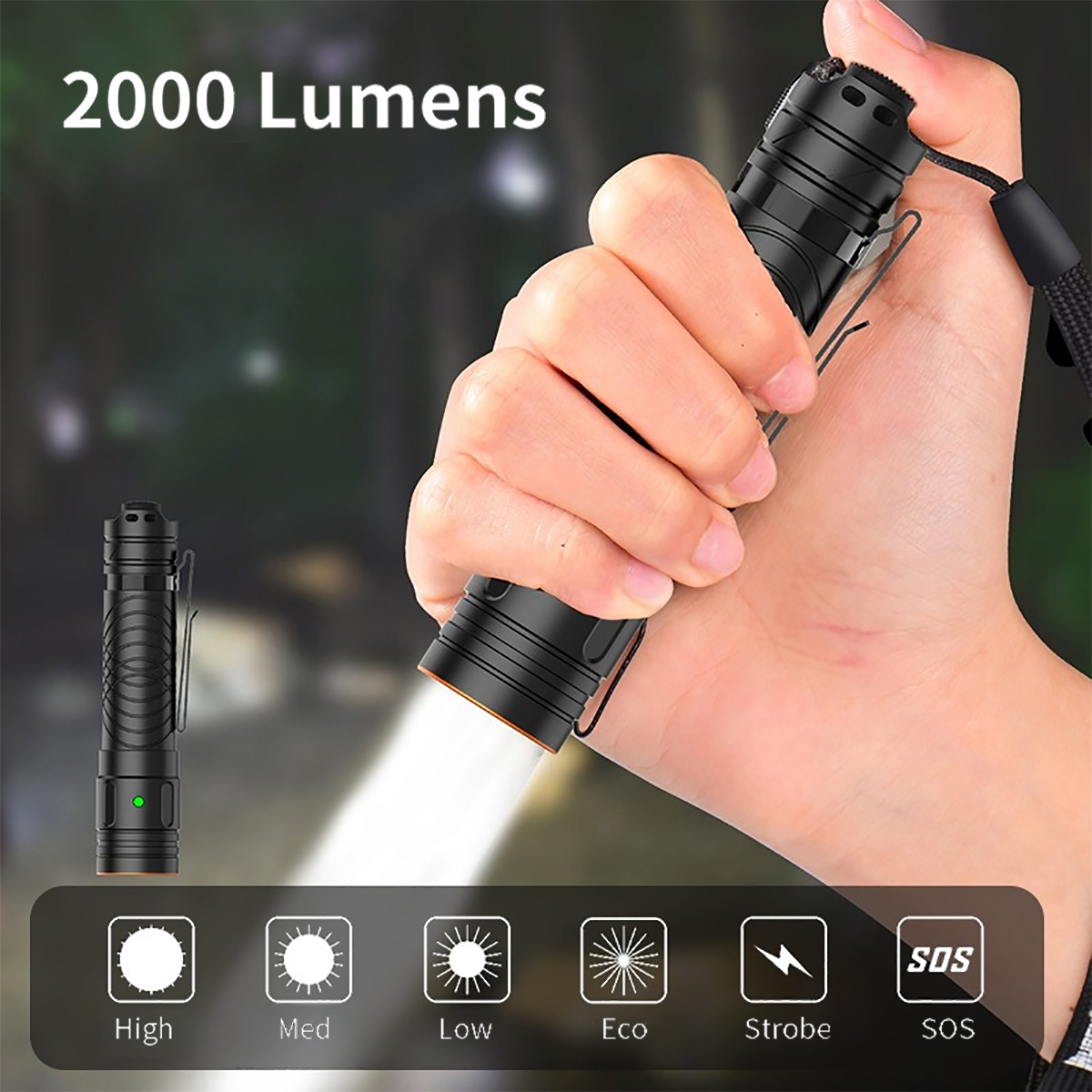
The MCU is the computational brain of the driver. It executes the firmware responsible for interpreting user switch inputs, managing complex UI logic (High, Low, Strobe, SOS), and generating the precise PWM (Pulse Width Modulation) signals required for dimming. Furthermore, it reads data from NTC thermistors to execute Advanced Temperature Regulation (ATR), dynamically stepping down the current if thermal limits are breached.
Power Devices: MOSFETs vs. BJTs
While legacy electronics utilized Bipolar Junction Transistors (BJTs), modern high-power tactical flashlights exclusively deploy MOSFETs (Metal-Oxide-Semiconductor Field-Effect Transistors). Unlike current-controlled BJTs, MOSFETs are voltage-controlled devices. Crucially, they possess an exceptionally low Drain-Source On-Resistance ($R_{DS(on)}$). According to Joule's first law ($P = I^2R$), a lower internal resistance results in exponentially higher switching efficiency and drastically less parasitic heat generation under massive multi-ampere currents.
Inductors & Capacitors
In switching driver topologies, passive components are critical for energy manipulation. Inductors resist changes in current ($V = L \frac{di}{dt}$); they temporarily store energy in a magnetic field, enabling Boost (step-up) or Buck (step-down) voltage conversion. Capacitors serve as electronic shock absorbers, smoothing out voltage ripples and filtering the high-frequency switching noise. This vital filtering process ensures the LED receives a pure, flat direct current, entirely preventing optical flickering.
III. The Physics of Constant Current (CC) Drive
A Light Emitting Diode is a non-linear semiconductor. A fractional increase in forward voltage ($V_f$) results in an exponential, runaway increase in forward current ($I_f$). Conversely, if a flashlight relies solely on the raw voltage of a lithium-ion battery (which drops from 4.2V to 3.0V as it depletes), the LED's brightness will constantly and noticeably decay.
Linear vs. Switching Regulation
To guarantee consistent brightness and prolong the LED's lifespan, the driver must enforce Constant Current (CC) regulation.
Linear Driver ICs: Components like the legendary AMC7135 chip operate by sinking a precise, fixed current (e.g., 350mA per IC). By wiring multiple chips in parallel, engineers scale the total current. However, linear drivers burn off excess battery voltage as pure heat ($P_{loss} = (V_{in} - V_{out}) \times I$). They are highly efficient only when the battery voltage is very close to the LED's forward voltage.
Advanced Switching Regulators: For extreme efficiency and multi-cell configurations, Buck, Boost, or Buck-Boost topologies are utilized. By rapidly toggling a MOSFET and utilizing the inductive flyback effect, these circuits mathematically convert voltage into current with efficiency rates often exceeding 90%. A switching regulator actively monitors the current across a sense resistor and adjusts its PWM duty cycle in microseconds. This ensures that the LED receives a perfectly stable, unyielding current—maintaining 100% brightness until the battery's protective cutoff is reached.
Conclusion
The modern tactical flashlight is a marvel of electronic miniaturization. The successful integration of high-amperage MOSFETs, DTP Copper substrates, and intelligent microcontrollers requires an absolute mastery of thermodynamic routing and Electromagnetic Compatibility (EMC).
Achieving precise power management within the extremely confined geometry of a flashlight head relies heavily on advanced PCB Layout engineering. Because these micro-components must endure extreme thermal cycling, violent weapon-recoil G-forces, and strict global safety standards, engineering such systems remains the exclusive domain of an elite, scientifically dedicated Flashlight OEM/ODM Manufacturer.